What is a commercial rotisserie oven and how does it work
To understand whether this equipment is still suitable for your business, it’s worth starting from the basics. A commercial rotisserie oven is a machine designed to cook large quantities of meat evenly, especially chickens, using a system of rotating spits positioned in front of a constant heat source.
How does a commercial rotisserie oven work? The principle is simple: cooking occurs by radiation. Whether it is a commercial electric rotisserie oven or a gas model, the logic does not change. Heat is generated by burners or heating elements located at the back of the machine, while the rotation of the spits helps distribute the product’s fats more evenly during cooking.
How do you use a commercial rotisserie oven at its best? Since this is a dry-heat cooking method, the meat’s own fat must be used to keep the product tender during cooking. However, to achieve a consistent result, it is essential to properly manage rotation, timing and the arrangement of the load on the spits. The more uniform the product is in size and type.
What you can cook in a commercial rotisserie oven
Although the term “rotisserie” immediately brings to mind the classic chicken shop, the actual versatility of this machine depends on the spits (rods) used. What can you cook in a commercial rotisserie oven? The undisputed star is rotisserie chicken: thanks to constant rotation, the meat undergoes a sort of “self-basting” process, where the juices continuously coat the product, ensuring crispy, golden skin and a tender interior. Can you cook other types of meat besides chicken? With the right technical adjustments and the use of long fork spits or basket cages, it is possible to expand the menu to include porchetta, roasts, pork knuckles and small game, while paying attention to heat control to prevent more delicate meats from drying out.
From a productivity standpoint, it is hourly revenue that sets the rules. For example, how many chickens can a 6-spit rotisserie cook at once? In a 6-spit commercial rotisserie oven (with 90–100 cm spits), the average capacity is 30–36 chickens per cycle, considering a standard size of 1–1.2 kg. However, the process requires strict planning: a full cycle lasts between 70 and 90 minutes, which means slow “reaction times” if sudden demand exceeds available stock.
The limits of commercial rotisserie ovens
Is a commercial rotisserie oven still worth it? Beyond limited cooking flexibility, there are logistical and management factors that can make a traditional rotisserie oven a complex choice for certain types of settings. Let’s analyse the key points to consider before purchasing new equipment.
Footprint and kitchen layout
Commercial rotisserie ovens are available in both countertop and column versions, but in most cases they are still pieces of equipment with a significant footprint. Even the most compact models require dedicated space and have a major impact on the kitchen layout. This means that part of the operating area is tied to a machine designed for one specific function, reducing flexibility in the arrangement of other equipment or workstations.
Cleaning and grease management
How do you clean a commercial rotisserie oven? Most traditional models available today still require manual cleaning, which means more time, attention and frequent intervention on the parts most exposed to grease and cooking residues. Rotisserie ovens with automatic washing also exist, but they are often bulkier and more expensive solutions.
Maintenance
A rotisserie oven is a machine with a strong mechanical component, exposed to continuous use and high temperatures. The motors that enable spit rotation, together with the internal parts exposed to heat and grease, are subject to wear over time. For this reason, regular maintenance is necessary, especially in high-production businesses, to avoid performance drops or machine downtime.
Operator safety
Daily use of a commercial rotisserie oven involves some operational risks that should not be underestimated. Loading chickens onto spits requires the use of pointed elements, while during service operators need to handle loaded rods that are heavy and extremely hot. On top of this, there is contact with grease and cooking juices at high temperatures.
All these factors increase the risk of burns, slips and injuries, especially in fast-paced, high-intensity working environments.
Limited flexibility
The most obvious limit of a rotisserie oven remains its operational rigidity. It is a machine designed for a specific type of cooking and, once in use, it can hardly be used for other preparations. This means dedicating space, time and energy to a piece of equipment that cannot be used to expand the offering or easily adapt to different needs.
In a context where kitchens need to be increasingly flexible and efficient, this specialisation can become a real limit to business growth.
The combi oven as an alternative to the commercial rotisserie oven
In many professional kitchens, the commercial rotisserie oven remains an effective solution, especially when production is focused on a single product such as rotisserie chicken. However, more and more businesses need to manage different requirements: expanding their offer, optimising space and maintaining consistent quality standards across multiple preparations.
This is exactly where the commercial combi oven comes into play. What is the difference between a combi oven and a commercial rotisserie oven? Unlike the rotisserie oven, which works with constant heat and rotation, the combi oven uses ventilated hot air and steam, allowing precise control of temperature, humidity and ventilation.
This greater control does not only mean more versatility in preparation, but also more uniform and repeatable quality over time. In other words, the difference is not only what you can cook, but how much control you have over the final result. Today’s available technologies make it possible to achieve very high standards and, at Unox, we have been working alongside professionals for decades to develop intelligent technologies that can adapt concretely to the needs of every business.
The advantages of a Unox combi oven compared to a rotisserie oven
Before choosing the most suitable solution for your business, it is useful to understand the concrete advantages a combi oven, and especially a Unox solution, can offer in daily kitchen management. Over the years, we have seen more and more delis, supermarkets and restaurants integrate combi ovens to improve productivity, quality and cooking control.
Versatility of use
A commercial rotisserie oven is designed for one specific process. If you want to prepare side dishes, first courses or other meats, you necessarily need to add other equipment such as hotplates, grills or additional ovens.
With a combi oven, on the other hand, you can manage everything with a single machine: from cooking chicken to vegetables, lasagne, roasts and more complex preparations. Unox combi ovens such as those in the CHEFTOP MIND.Maps™ range allow you to grill, roast, steam and much more, with precise control and simplified management even for less experienced staff, thanks to a library of automatic programmes that are easy to start.
This means you can easily expand your offering: not only serving chicken with some of the most popular side dishes, such as potatoes, grilled vegetables or gratins, but also growing your menu over time. If your business started with rotisserie chicken and you now want to introduce new preparations, a combi oven gives you the flexibility to do so without multiplying equipment, space and operational complexity.
Cooking quality and results
One of the most common questions when considering a combi oven instead of a commercial rotisserie oven is: does the chicken come out as crispy as it does in a rotisserie oven?
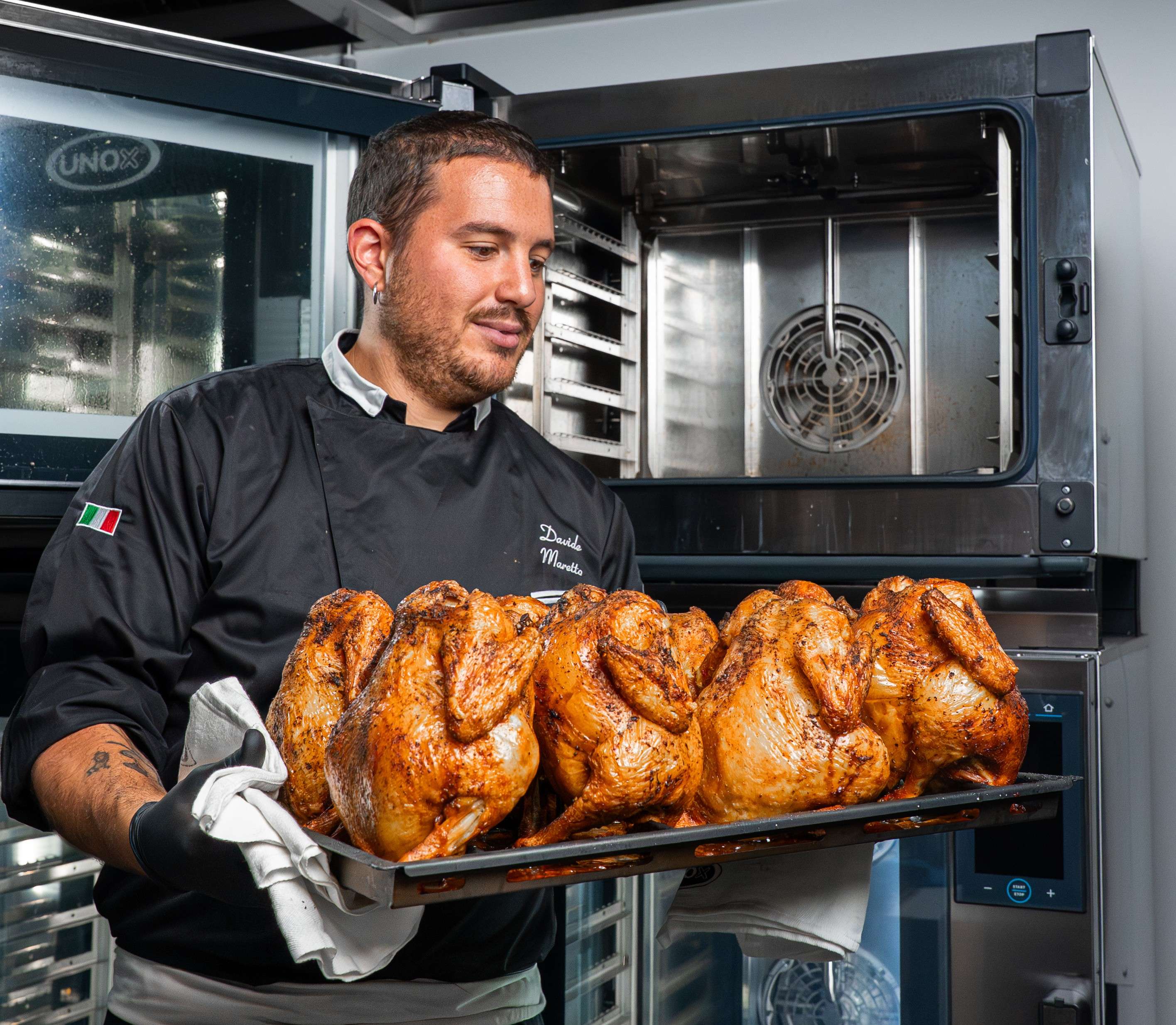
The answer is yes. Thanks to humidity control and ventilation, it is possible to obtain crispy skin while keeping the inside juicier, also reducing the risk of dehydration. In addition, precise control of cooking parameters guarantees consistent results even at full load, repeatability and better product holding over time.
As our Nicola Lai, Corporate Chef Manager of the Unox Team, also explains:
“The difference lies in humidity control. With a combi oven, you can precisely manage humidity levels at every stage of cooking, regardless of how many chickens are loaded. This makes it possible to achieve uniform, repeatable results. Heat remains essential for developing browning and external crispiness, but the real value is on the inside: juicier meat, cooked more evenly and with less stress. And that juiciness makes a difference even after service, especially when the chicken is sold for takeaway and the customer reheats it at home.”
Higher product weight yield
For those who sell chicken or other preparations by weight, yield is far from a secondary issue. One of the most concrete advantages of a combi oven is the ability to better control weight loss during cooking. In practice, the product retains its liquids better and dehydrates less than with completely dry cooking. This means a juicier final product, but also more sellable weight from the same raw material. For example, a 1 kg chicken cooked in a commercial rotisserie oven can reach 700-750 g, while with a more controlled cooking process it can remain at around 800-850 g. In this case, the difference translates directly into margin.
Costs, consumption and product yield
In addition to the economic advantage linked to reduced weight loss compared to a commercial rotisserie oven, a combi oven allows you to optimise costs because with a single machine you can manage multiple preparations and replace different pieces of equipment, saving space, energy consumption and operating time.
In terms of energy efficiency, Unox combi ovens go one step further: Unox is in fact the world’s leading manufacturer by number of ENERGY STAR® certified ovens, thanks to advanced insulating materials, lower heat dispersion and intelligent technologies such as SMART.Energy, which makes energy saving automatic too.
To give a concrete example, compared to a traditional gas commercial rotisserie oven, an ENERGY STAR® CHEFTOP MIND.Maps™ 10-tray professional electric oven can reduce consumption by up to around 65% over 10 years, considering an average production of 50 kg of food per day.
This data comes from tests we carried out internally, which you can explore further in our dedicated article!
Space and productivity
With a combi oven, it is possible to concentrate multiple processes into a single solution, optimising available space and making the kitchen more flexible. With the same footprint, in fact, you can increase productivity and handle different preparations without multiplying equipment.
A concrete example is vertical configurations such as the CHEFTOP MIND.Maps™ 6+6 column with SMART.Drain. In this case, you have two ovens that can work simultaneously on different preparations, with the added benefit of automatic grease collection. In practice, you can cook chicken in one oven while managing side dishes, roasts or other deli preparations in the other, making better use of space and increasing production capacity without complicating the kitchen layout.
Cleaning and operational management
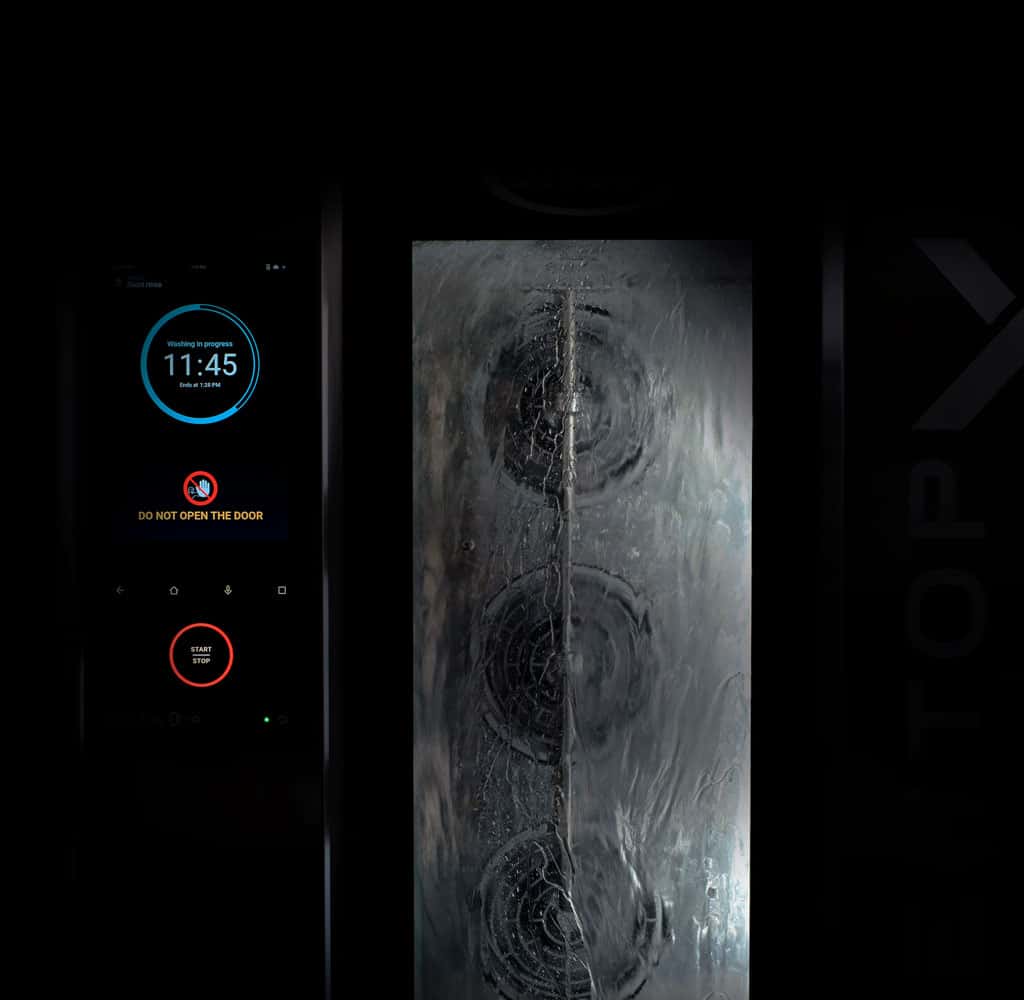
Another aspect that greatly influences the choice of equipment is the time staff need to dedicate to cleaning. Unox combi ovens are designed to simplify this phase too, thanks to automatic washing systems that reduce manual work and help maintain high hygiene standards more easily. In addition, intelligent technologies integrated into Unox professional ovens, such as SENSE.Klean, allow the oven itself to suggest the most suitable washing programme based on the level of dirt, avoiding unnecessary waste and making daily management much more straightforward.
Operator safety
Safety is another aspect that should not be underestimated. In a commercial rotisserie oven, daily operations require loading, unloading and handling hot, heavy and bulky spits, with greater exposure to repetitive, awkward or potentially risky movements.
With a combi oven, on the other hand, the workflow becomes simpler and more ergonomic: trays are easier to handle and contact with very hot or difficult elements during service is reduced. Added to this is another important advantage: lower exposure to fumes, vapours and dispersed grease, which helps create a safer and more comfortable working environment for staff.
Grease management and reduced smoke
In a combi oven, fats and cooking liquids are collected and managed in a more controlled way. This helps reduce smoke in the environment, keeps the air cleaner and simplifies waste management.
In addition, for settings without a traditional kitchen or dedicated extraction system, Unox offers specific solutions such as our Ventless hoods with activated carbon filters and a condensation system. These make it possible to install the oven even in customer-facing spaces, containing odours and vapours.
In practice, this means being able to expand the offering in environments such as supermarkets or food corners with greater design freedom, without the constraints of a traditional kitchen.
Do you want to know which solution is best for your business? We have created a dedicated guide to help you make the right choice!
Unox accessories for cooking chicken
What accessories are needed to cook chicken in a combi oven? To get the most out of a combi oven when cooking chicken, it is not only the oven technology that matters, but also the choice of the most suitable accessories. As mentioned in the previous paragraph, it is precisely the integration between dedicated internal equipment and grease management that makes the process more efficient, cleaner and easier to standardise over time.
SMART.Drain: simpler management of grease and cooking liquids
One of the most delicate aspects of cooking chicken is grease management. With the SMART.Drain system developed by Unox, cooking fats are separated and collected in a more orderly way, preventing them from going directly into the drain and making both cleaning and final residue management easier.
This is an important advantage from both an operational and safety perspective: cooking fats can solidify in pipes, causing blockages, unpleasant odours and unexpected maintenance costs. In many professional settings, grease residue must also be managed according to specific procedures to avoid drainage issues and comply with good kitchen practices.
The benefit is practical and immediate: less dirt inside the oven, less smoke during service and a lower risk of clogged drains. In addition, grease collection becomes more orderly and safer for staff, who do not have to handle hot residues manually at the end of cooking.
Dedicated trays: more uniform cooking and easier cleaning
Internal accessories also make a big difference. For cooking chicken, Unox has developed specific trays designed to improve air circulation and the final product result.
These include solutions such as POLLO.GRILL, which allows chickens to be positioned vertically to promote uniform cooking, and POLLO.BLACK, designed to accelerate heat transfer and achieve faster, more even browning.
Thanks to its non-stick coating, POLLO.BLACK does not require abrasive sponges: a simple rinse is enough to remove residues and prepare it for the next cycle. This reduces cleaning time between cooking cycles, simplifies staff operations and makes production easier to organise, increasing efficiency and safety.
These are complemented by the grease collection tray, positioned at the bottom of the oven to channel liquids and residues, reduce dirt and make final washing easier.
In this way, both cooking quality and daily operational management are improved.
We have developed accessories designed to meet the needs of every business: discover all Unox solutions to optimise kitchen operations!